Showing posts with label map. Show all posts

Sunday, February 5, 2012

Progress: February 5, 2012


I recently learned an important lesson about diversifying my genealogical research. Databases all have their own particular quirks and transcriptions of microfilms can vary widely. For instance, errors made while transcribing documents, as well as the widespread practice of misspelling the foreign sounding names of newly arrived immigrants in North America have resulted in variations in the spelling of certain family names. My great grandfather's name varied from census to census: Angerbauer (1880, USA), Angarbanr (1900, USA) and Angerbaur (1916, Canada).

I had been using Ancestry.com for the last couple of months and felt like I had reached a standstill. I decided to try FamilySearch, which is affiliated to the Mormon Church. Unlike Ancestry.com, which requires a paid subscription, the FamilySearch site gives free access to transcriptions of the many Canadian records on microfilm.

Surprisingly enough, when I queried their database, it was able to make the phonetic link between Angerbauer and Angesbower, bringing up a birth record in 1897 for a “child Angesbower” in New Jersey. As the date matched that of Frances, the eldest of his daughters, I knew it was a positive match. As censuses only list the head of the household’s family name, I had not previously known the maiden name of my great grandmother. All I knew was that she was born in Canada in 1871, and that she was of Scotch descent. Giving recourse to another genealogy portal proved to be a sound decision. One phonetic association provided me with a vital piece in the puzzle. Mary Angerbauer was born as Mary I. McKay.


McKay - Isle of Lewis

McKay - Scottish and northern Irish: Anglicized form of Gaelic Mac Aodha ‘son of Aodh’, an ancient personal name meaning ‘fire’. Etymologically, this is the same name as McCoy. (Dictionary of American Family Names, Oxford University Press) — Ancestry.com


I had previously wondered why Mary Angerbauer had moved to Kincardine from New Jersey without her husband, before settling with him in Winnipeg, Manitoba five years later according to the 1916 Canada Census? Her maiden name partly explained why she was listed in the 1911 Fifth Census of Canada for the Bruce North along with her five daughters: Francis, Ruth, Muriel, Catherine and Keneena. It could be that her parents, who were born in Scotland, were one of the McKay families of the Lewis settlement in Bruce County, Ontario. Whole populations of the Scottish Highlands were expulsed from their lands in the 18th and 19th centuries in what was known as the Highland Clearances. (Wikipedia).


Kincardine Towneship
Kincardine was once known as Penetangore from the serpentine river of the same name. Robertson explains that it stems from the Indian name Na-Benem-fan-gaugh, which means ‘the river with the sand on one side”. (p. 429)


A. R. MacKinnon explains how there was a strong concentration of Gaelic speakers from the Isle of Tiree (Scotland’s Inner Hebrides) in Kincardine, but that the largest group of Gaelic speakers was the Lewis Settlement in the neighbouring township of Huron ("Gaelic in the Bruce", 1967). This settlement consisted of families that were evicted from their crofts on the Isle of Lewis in the Outer Hebrides of Scotland in the mid 19th century and who immigrated to Canada because they were offered free passage in return for their land. Two shiploads left Stornoway on May 30, 1851 and arrived in Montreal in August 1851. A year later, 109 families settled in the township of Huron in Bruce County according to the Bruce County Genealogical Society.


Huron Towneship


In The history of the county of Bruce and of the minor municipalities therein (1906), Norman Robertson paints a picture of the hardships that the settlers were confronted with in a new country as Gaelic speakers:

As is elsewhere pointed out, the settlers who first peopled the county of Bruce were, as a whole, of numerous and varied vocations, and in regard to nationality they were pretty thoroughly mixed up. This heterogeneity served a good purpose in the making of the county.  Huron Township received at one time, in the fall of 1852, a large group of settlers, sufficient if so allocated to have taken up every lot on three concessions, who differed in every respect from the fore- going. This was the Lewis settlement. It consisted of one hundred and nine families who took up land in the centre of the township. These were all from the Island of Lewis, and had been evicted from their croftings by their landlord, Sir James Matheson. Laboring under the disadvantage of being able to speak English but imperfectly Gaelic being their mother tongue, many, indeed, could speak no other and whose calling was that of sailors or fishermen, they were utterly ignorant of how to set to work to clear up a bush farm, and lacked also the necessary experience how to work it after it had been cleared. In addition to this, being settled close together they had consequently no opportunity to study the object lesson which a native Canadian backwoodsman in his daily task of chopping, logging and ploughing would have set before them. Is it any wonder, then, when all these circumstances are considered, that the progress of the Lewis settlement was at the first slow.

Robertson includes the McKay family name in a list of early Lewis settlers: Angus McKay and  John McKay settled on the 5th concessions, while Malcolm McKay, John McKay, Norman McKay, John MacKay, Angus McKay and Murdoch McKay settled on the 6th concessions. He also mentions a McKay along with other Highland Scotch settlers in the chapter on the Kinkardine township, but he does not go into detail safe to mention a Hector McKay who entered the ministry in the Presbyterian Church. So far, my research has brought up hundreds of Mary McKay’s in Canada alone, which has made the search for her exact birthplace quite difficult.

“There the fact is revealed that of all the townships in the county, Kincardine alone had a smaller population in 1901 than it had in 1861, and 1,651 less than in 1881. “Where has the population gone?” is but a natural question. Ask the Western States and our own Western Provinces. There, in numerous prominent positions, as well as on ranches, farms and mines, are to be found the “Old Boys” of Kincardine Township, with a warm, warm place in their hearts for the place of their birth.” (p.438)

This passage stood out for me thinking back of the westward migrations in my own family history.


Friday, January 20, 2012

Progress: January 21, 2012


1900 Census


My great-grandfather was born in the former Kingdom of Württemberg in 1840, what is known today as the south-western state of Baden-Württemberg in Germany. Joseph Angerbauer's naturalization record indicates that he became a United States citizen on May 31, 1870 and settled in Westchester Co, New York. Census records state his occupation as a labourer.

As I have not yet been able to find his name in ship passenger lists, I wonder if he immigrated to the States illegally? Though he could have emigrated to escape religious persecution, it is perhaps more likely, considering the year, that he left his country to avoid military service because Germany practiced compulsory military conscription at that time. The Franco-Prussian war broke out on July 19, 1870 and ended on May 10, 1871, the result of a conflict between the Second French Empire under Napoleon III and the Kingdom of Prussia. The South German states of Baden, Württemberg and Bavaria joined together with the North German Confederation to aid Prussia. (Wikipedia)

In fact, his name does not surface in the Württemberg Emigration Index, a database compiled by Trudy Schenk, which contains the names of approximately 60,000 persons who applied to leave Germany from Württemberg from the late 1800s to the early 1900s.

Yet, surprisingly, I found the Angerbauer surname in the Consolidated Jewish Surname Index on the Avotaynu website; it is included in Lars Menk’s Dictionary of German-Jewish Surnames (Bergenfield, 2005). This dictionary identifies more than 13,000 German-Jewish surnames from pre-World War I Germany, including Baden-Württemberg.

Though I could not find the meaning of the Angerbauer surname, "Anger" is defined by the Dictionary of American Family Names (Oxford University Press) as follows:

South German: a topographic name from Middle High German anger ‘meadow’, ‘village green’.
French and English (of Norman origin): variant of the personal name Angier.
French: variant of the habitational name Angers. (Ancestry.com)

“Bauer’ is defined as German and Jewish (Ashkenazic). It’s said to be a

“status name for a peasant or nickname meaning ‘neighbor’, ‘fellow citizen’, from Middle High German (ge)bur, Middle Low German bur, denoting an occupant of a bur, a small dwelling or building. Compare Old English bur, modern English bower. This word later fell together with Middle High German buwære, an agent noun from Old High German buan ‘to cultivate’, later also (at first in Low German dialects) ‘to build’. The German surname thus has two possible senses: ‘peasant’ and ‘neighbor’, ‘fellow citizen’. The precise meaning of the Jewish surname, which is of later formation, is unclear. AB” (Ancestry.com)

I’ll need to get my hands on the Dictionary of German-Jewish Surnames to further my research.


Sunday, June 12, 2011

Process: Griffintown sladdakavring


UNESCO designated April 18th as the International Day for Monuments and Sites in 1983. Heritage Montreal, in collaboration with ICOMOS Canada, brought together several partners to highlight this year’s theme, the Cultural heritage of water in Montreal. Parks Canada put on a conference about the Lachine Canal National Historic Site at Brasseurs de Montréal. While on the guided tour of the canal and its basins, admittedly a cold and wet experience as it rained buckets the entire time, I discovered that The Canada Jute Company used to occupy the building situated at 1744 William Street, which was built in 1889. Specializing in the making of industrial bags in jute and cotton, The Canada Jute Co. was incorporated in 1882 and amalgamated into The Canadian Bag Company in the 1900s.

The proximity of the Ogilvie Flour Mill on rue des Seigneurs (built in 1890, and later occupied by Montreal Woolen Mills), prompted me to wonder if Canada Jute Co. provided the mill with jute bags for its flour and middling products? A material that is considered a waste product along with the bran, middlings or weatlings (in French, remoulage or issues), is obtained in the commercial wheat milling process and was commonly used to feed livestock as a high-protein supplement.


Lake of the Woods Tongue Rug
Lake of the Woods Tongue Rug, c. 1930
Reverse view of the burlap bags from Lake of the Woods Milling Company Ltd.


At first, I wondered if there was a Griffintown connection to my sladdakavring? Did The Canadian Bag Company fabricate the middling bag that is stitched on the back of my tongue rug? Upon further investigation, I realized that it is more plausible that the maker of the rug simply lived on a farm or maintained a small stable on their property because Ogilvie Flour Mills only bought Lake of the Woods Milling Company in 1954, while the tongue rug is dated around 1930. It will be difficult to determine the origin of the rug given that middlings were sold all over Canada and the United States to feed livestock.

When I first settled down in the Sud-Ouest in 2007, I walked the Griffintown and Point St. Charles Heritage Trail to explore the area. Hailing from an industrial city in Northern Ontario, I've always appreciated the singular beauty of 19th & early 20th century industrial architecture. I’ve been walking and biking through Griffintown on a daily basis as I started working at the Board of Montreal Museums Directors.


Engraving | Commercial trademark of William Dow & Company, Montreal, India pale Ale | M930.50.5.71


Curious about the area's architecture, I consulted McGill University's Industrial Architecture of Montreal website. The BMMD building situated at 333 Peel and William was once the garage of the William Dow Brewery Co., built in 1929 by the architect Louis Auguste Amos.


Engraving | Commercial trademark of William Dow & Company, Montreal, India pale Ale | M930.50.5.71
Engraving: Commercial trademark of William Dow & Company, Montreal, India pale Ale
John Henry Walker (1831-1899)
© McCord Museum


I also recently stumbled upon a heritage study of 55 buildings in Griffintown — residential housing, institutional, commercial and industrial buildings — on the Committee for the Sustainable Redevelopment of Griffintown website. Planification détaillée du secteur Griffintown: analyse du cadre bâti was produced by the consulting firm Patri-Arch (Martin Dubois and Catherine Séguin with David B. Hanna and Atelier B.R.I.C.) for the Bureau du patrimoine de la toponymie et de l’expertise du Service de la mise en valeur du territoire et du patrimoine for the City of Montreal in March 28, 2007. I decided to create a map using the study’s heritage sites as a starting point, in order to find my bearings while on my meanderings to and from work.


View Griffintown Heritage Buildings in a larger map


It was fascinating to see the transformations over time: from the photos taken during the study's 2006-2007 time period, to the Google Street View photos taken in 2009, to seeing the actual sites now, two years later, on my daily walks. I was frankly relieved to see that all the sites were still in existence with all the construction sites in the area. One of the study's suggestions was to design a series of informational plaques for these heritage buildings, a timely idea especially with all the recent real estate developments; from the well-known landmarks to the more modest dwellings, it is important to remind the passer-by of the varied history of this neighbourhood. The study certainly opened my eyes to the area’s industrial past and the key historical figures who helped shape the community.


Griffintown Police Station no 7, The Griffintown Tour by G. Scott MacLeod, 2001


I also found G. Scott MacLeod's website The Griffintown Tour, which showcases a series of drawings of key sites in Griffintown, namely Police Station no 7 situated at 219 Young Street. Built in 1875, it is now used as a rehearsal space for the Centaur Theatre Company. I recently enjoyed a guided tour of the building. Urban Occupations Urbaines, in collaboration with the Centaur Theatre and Heritage Montreal presented Alison Loader's Ghosts in the Machine, an inquiry into the death of Mary Gallagher. I was impressed on many levels by this work.

I found the site-specific nature of her work a key component to the multimedia installation. The historical signification of the building for the Irish population at the time and the "residue" of a 135-year-old space added to the experience: the creaking of the floorboards, the smells and the general atmosphere. I appreciated the fact that there were multiple entry points, that is, each person would have a different experience based on their vantage point of the projections; each person, depending on when they entered the installation, would experience the narrative differently as there was no beginning nor end to the audio loops. One was free to creep up to see an image on the cylinder, to walk around the distorted projections or to simply sit down and listen. The imagination of the visitor — his or her ability to fill in the gaps — is another important component of this piece. The image of a nude figure with an axe for example, becomes a skewed image of some sort of animal galloping in a monstrous manner. Closer investigation is needed to determine what one is looking at or what one is hearing as the audio of the three circular areas overlap. The piece is interactive in that it demands work; visitors need to spend time with the installation to put together the pieces, to reassemble the bits of information that they are hearing and seeing. This process of reconstitution mirrors the multiple points of view at the time on the crime (the beheading of Mary Gallagher) as well as the societal biases around women and class that came to corrupt the justice process in finding her killer.

It would be interesting to have a permanent exhibition of Lauder's work in Griffintown much like the Silophone project in the Old Port.

Sunday, April 24, 2011

Process: Isidore and Rose Alma Legault


LE-1

Legault Waterway
Plaisance, Papineau, Outaouais, Quebec, CA

Cours d'eau Legault
Plaisance, Papineau, Outaouais, Québec, CA

Tweet your story @tongue rug or fill out a short form!
Tweetez votre histoire @tonguerug ou remplissez un formulaire!


I decided to follow the same process as the Lapalme map and superimpose multiple generations of Legaults with the respective tongue rug placenames. I started with Roch Legault (Legoff) in Irvillac, France and moved westward.


View Legault Ancestors in Canada in a larger map


Just as I suspected, five generations of Legaults have lived in proximity to the waypoints that are concentrated in the Outaouais region: LE-1, LE-8, LE-10 and LE-6.

  • Jacques Legault
    (b. Sep 19, 1764, Pointe-Claire, d. Mar 18, 1847, Montebello, Papineau, QC)
  • Michel-Amable Legault
    (b. Nov 16, 1809 Rigaud, Vaudreuil, d. Sept 11, 1906, St-André Avelin, Papineau, QC)
  • Justinien Legault dit Délaurier
    (b.  Feb 1831, Rigaud, Vaudreuil, St-André Avelin, Papineau, QC)
  • Isidore Emirie Legault
    (b. Abt, 1856-1876, St-André Avelin, Papineau, QC)
  • Isidore Legault
    (b. May 7, 1918, St-André Avelin, Papineau, QC, Apr 8, 2007, Sudbury, ON)

I remember when cycling to each of these bodies of water, I passed by many farms. Most of the Legaults were listed in censuses as farmers or cultivators. My grandfather Isidore had worked as a lumberjack before injuring himself. It was the thriving forestry industry in Northern Ontario that triggered his move northwest.

I was unable to find much info on Isidore Emirie Legault?

Saturday, April 23, 2011

Process: Sigefroi et Herméline Lapalme


LA-3

Lapalme Waterway
Saint-Esprit, Montcalm, Lanaudière, Québec, CA

Cours d'eau Lapalme
Saint-Esprit, Montcalm, Lanaudière, Quebec, CA

Tweet your story @tongue rug or fill out a short form!
Tweetez votre histoire @tonguerug ou remplissez un formulaire!

Corresponding with another person doing genealogical research on the Lapalme family, I found out that we were distant cousins: my great-great-great-grandfather Sigefroi Lapalme (1827) was the brother of his relative, Théophile. While updating my files, I realized that some of my Lapalme waypoints for the tongue rug were situated near my ancestors' birthplaces.

The Lapalmes can be traced back to Martin Janson (1605) in St-Sulpice, Paris, France. I was able to mark thirteen generations on the map. Though my water icons do ressemble Easter eggs somewhat, it still gives me a general idea of the influence of family groupings on toponymy.


View Lapalme Ancestors in Canada in a larger map


In fact, the last waypoint I visited, Lapalme Waterway (LA-3) near L’Assomption, was indeed the birthplace, or at least the residence, of five generations of Lapalmes.

  • Christophe Jeanson dit Lapalme (b. Jul 19, 1694 in Québec (Québec), d. Aug 20, 1778, L'Assomption, Québec.)
  • Louis Janson (Jeanson dit Lapalme) (b. Sep 12, Apx. 1730, Pointe-aux-Tremble, Québec, d. June 9, 1802, L'Assomption, Québec)
  • Louis-Marie Janson-Lapalme (b. Aug 27, 1758, St-Pierre-du-Portage, L'Assomption, Québec, d. Mar 4, Apx. 1819, L'Assomption, Québec)
  • Louis Jeanson (Janson) (b. Sep 24, 1799, d. March 24, 1877, L'Assomption, Québec)
  • Louis Janson (Jeanson-Lapalme) (b. Dec 9, 1830, St-Pierre-du-Portage, L'Assomption, Québec)
  • Sigefroi Lapalme (b. Mar 15, 1825, St-Esprit, Québec, d. April 28, 1896, Embrun, Russell, Ontario)

Sigefroi Lapalme had moved to the largely French-speaking agricultural community of Embrun in Eastern Ontario where my grand-father was born two generations later.

I would have matched the placenames and the Lapalme lineage much sooner if it were not for the fact that my computer had been stolen a few years ago. I lost many personal files and even artwork related to the Tongue Rug project. I was devastated at the time, but I eventually just started over. I thought it ironic that I was once again reconstituting missing information — piecing together parts of my family history much like the crafting of a traditional tongue rug.

Sunday, September 5, 2010

Progress: September 5, 2010


Now that I have completed the fieldwork for Tongue Rug — it was inconceivable to be able to document all of the waypoints by bicycle — I am free to simply explore the Montreal Island and its vicinities while I work on other aspects of the project. I stumbled across a nicely detailed map for The West Island Heritage Bicycle Trail while researching Legault placenames; four houses on the island can be traced to the Legault dit Deslauriers family.


View Historic Legault houses in a larger map


As it was a brisk fall day, I decided to venture out on a scenic ride to Pierrefonds. There was a dilemma however. If I were able to cycle north-west as the crow flies from the Lachine canal, it would have been a relatively short route. Unfortunately, the north-south cycling paths on the island leave much to be desired. I had to go east then north using the Christophe-Colomb route, then west again to reach my waypoint. The return trip ending up being a 70 km ride. Though there is surely another way to get there, I admit that the bike path is a safer alternative. Plus, it was a glorious day for cycling with a bright sun and a cool breeze. Everyone seemed to be out on the trails.

The ride to Pierrefonds was also worth the ride considering the varied architecture found on Boulevard Gouin and the ride through the Parc-Nature-du-Bois-de-Saraguay, home to many species of rare trees such as black maple (érable noir or Acer nigrum), swamp white ash (frêne blanc or Fraxinus Americana) and common hackberry (micocoulier occidental or Celtis occidentalis). Will have to return on a day trip to visit this park.


The Maison Legault dit Deslauriers overlooked a small park facing the Rivière-des-Prairies. The West Island Heritage Bicycle Trail had erected a small panel that listed the year of construction as 1789. The fieldstone farmhouse was inhabited by Legault family members and passed from generation to generation. The architecture adapts elements from the Québécois style (1760-1880) such as end-wall chimneys on opposite sides of the roof, commonly called “cheminées en chicane”. In 1908, it was transformed into a fashionable teahouse called “ Thé Habitant” by Mary Whitney Blaylock; the Duke of Kent was a visitor in 1930. It has since been a restaurant and a private home.

What was once known as the Lower Saraguay had changed considerably since the 18th century. Still, I could imagine a more rural habitat with meadows interspersed among the fieldstone farmhouses.


View Larger Map


I noticed a new function with alternative transport choices — public transport, cycling or walking — in Google Maps when I went to retrace my path. Now I can include one-way streets with cycling lanes in my routes. However, for this map the cycling option did not function. I used a beta version of the walking directions. Six and a half hours to walk that distance; four hours return on two wheels at a steady pace. How long would it have taken on horseback just a few centuries ago?


Friday, April 2, 2010

Progress: April 2, 2010


Made a map with my own set of custom icons: the thirty three tongues that make up the Tongue Rug. Google Sladdakavring version II. The majority span Quebec with a few waypoints in Ontario, Alberta and Sweden. The map invites interaction, as it is only at a certain scale that you get a sense of the Tongue Rug.


View Tongues in a larger map


A new addition to the Google Maps application is the ability to drag a Street View icon to any street on the map to see a representation of the area in 360 degrees. There is currently a bug where the Street View Icon kills the zoom function.

Yet this new feature does not particularly help me with my project because my waypoints are more often than not in the middle of a field, a forested area or a remote trail. Also, I still prefer the patchwork, imperfect nature of my photos in the round and the room for human error: the possibility that I could be documenting the wrong body of water in my searches, the likelihood that I will get lost.

Saturday, October 24, 2009

Progress: October 23, 2009


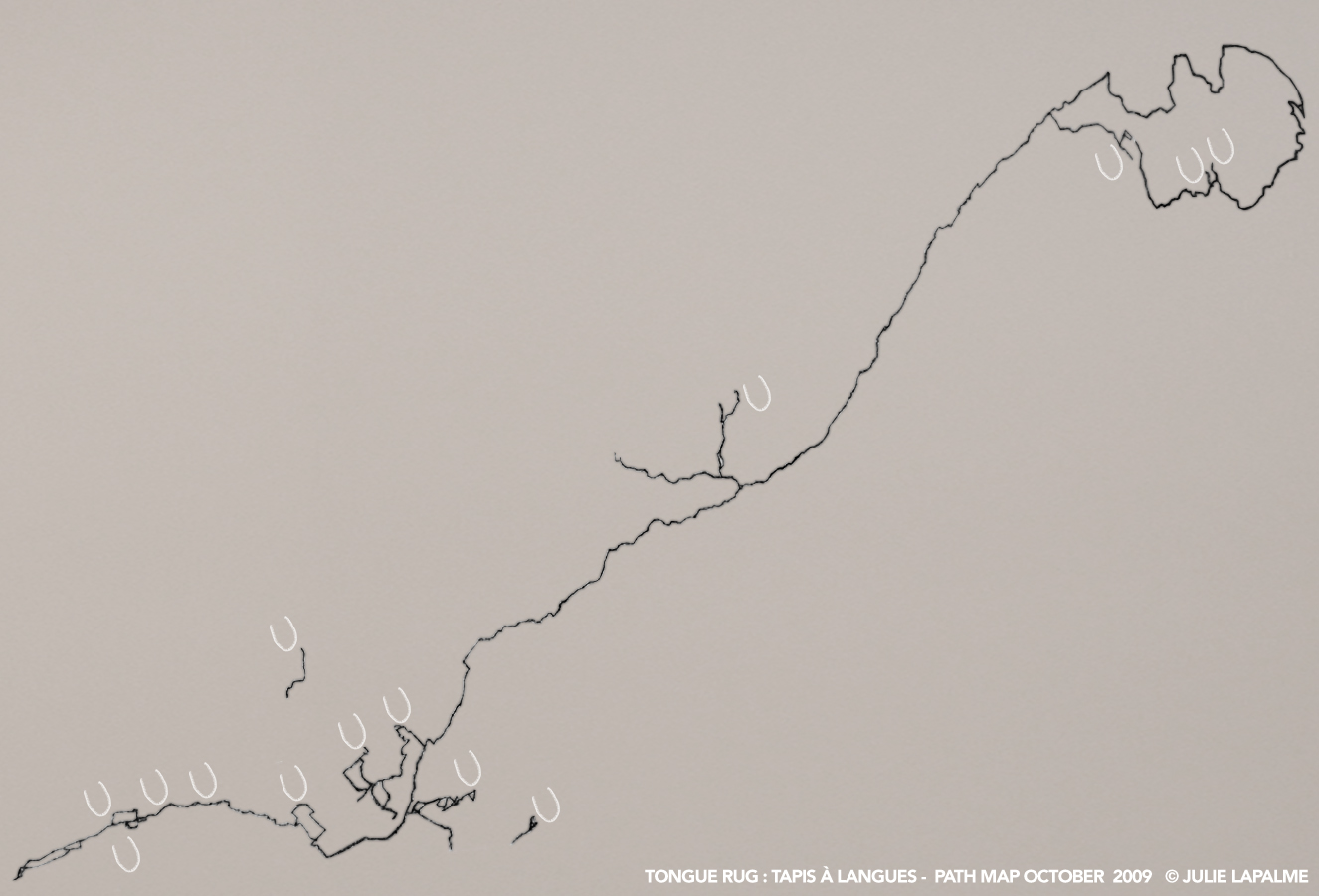
Though online apps (Bikely and Google Maps) do give me a general view of the paths I’ve been tracing over the years, I wanted a more complete picture. I had been treating the paths too piecemeal, needed to map them out to see the whole tracing. Took the Quebec road atlas that I had used to plan my bike trips, and photocopied a slew of pages. It was a pain to piece them together as the legend was different on certain pages — the Gaspésie tip is not quite to scale with the rest of the map. Also, it was hard to be precise as some pages did not align properly despite my efforts. Nonetheless, it was a satisfying exercise sitting on the floor cutting and taping together this growing map, page by page. To my surprise, I was left with a ten-foot long scroll of paper. Had to affix it to the living room wall to be able to see it in its entirety.


I crafted some ad hoc tongue-labels to mark out the waypoints and highlighted the paths. Stepping back I was a little shocked to see that I had traveled all that distance. The map was a visual manifestation of my moving through space, but also the time spent reaching each waypoint. It sounds silly to say, but I find it amazing how the human brain can look at a squiggly line on a map,  and this abstract symbol can trigger memories, sensations and inner pictures about having been in that space — in the flesh. That tension between the conceptual and the physical.

The paths themselves were intriguing as well. Their varied shapes were of course dependent on the terrain, but they were also testament to my lack of experience in the beginning of the project. LE-3 starts from Ste-Agathe des Monts and is not attached to the network as I had received a ride up to the Laurentians and rented a bike from the campground. I had not yet attempted long solo cycling trips. Also, A-9 is full of loops and backtracking as I was lost for most of the day, not properly focusing because I was cycling with a friend.


I’ve been making vector paths according to the topographical maps, but the precision makes it very time consuming. Went low tech: took a photograph of the wall and isolated the path in Photoshop. I wanted a quick overview of the pathmap.

In the beginning, the paths did not touch, but over the years, they did create a network — a tracing that largely follows the St-Laurent and the Outaouais river. I was pleased with how the crisscrossing lines looked like discarded thread. The tracing was random in the sense that I was cycling to the bodies of water with one of my family names that were nearest to me, by whatever path which facilitated my travels, further complicated by my admittedly inconsistent orientating skills.


Put some tongue markings as well — a little breast-like but no matter — to get a sense of the tongue rug progress. I don’t get a sense of the sladdakavring yet, as the waypoints are too spread out. I will experiment with other renderings.

Sunday, September 13, 2009

Progress: September 13, 2009


Uploaded the latest panorama to YouTube ( LA-3 ), probably the last one for this year. Making the Google map, it was satisfying to see my progress in a visual manner. The remaining waypoints will have to wait for warmer weather as they are remote and it would be unsafe to travel alone because of the bears. Berries were late this year due to the rainy summer; there has been more human-bear contact in the news lately. Many will die this winter because they did not fatten up enough to survive the long hibernation.

Yet, others can help me document the waypoints for my sladdakavring. Users can share their stories each placename as each tongue has a form so that they can submit their own story. I've heard about Lake Lapalme ( LA-1 ) in the Laurentians before setting foot in that area by reading about another's experience.


View Tongue Rug Status in a larger map


Legend: Blue = documented Red = undocumented Bold = documented

  • 021M Baie-Saint-Paul (1:250000)
    • 021M12 Lac St-Henri (1:50000) ( LA-5 LE-4 )
  • 022A Gaspé (1:250000)
    • 022A15 Sunny-Bank (1:50000) ( A-11 A-13 )
  • 022B Matane (1:250000)
    • 022B08 Rivière Angers (1:50000) ( A-11 )
    • 022B11 St-Jean-Baptiste-Vianney (1:50000) ( A-10 )
  • 022C Rimouski (1:250000)
    • 022C14 Lac Cassette (1:50000) ( A-8 )
  • 022D Chicoutimi (1:250000)
    • 022D03 Rivière Pikauba (1:50000) ( A-6 )
  • 022E Réservoir Pipmuacan (1:250000)
    • 022E09 Lac Gouin (1:50000) ( LE-5 )
  • 022F Baie-Comeau (1:250000)
    • 022F06 Lac Le Barbier (1:50000) ( LA-2 )
  • 031G Ottawa (1:250000)
    • 031G09 Lachute (1:50000) ( LE-9 )
    • 031G10 Hawkesbury (1:50000) ( LE-6 )
    • 031G11 Thurso (1:50000) ( LE-1 LE-8 LE-10 )
  • 031H Montréal (1:250000)
    • 031H07 Granby (1:50000) ( LA-6 )
    • 031H11 Beloeil (1:50000) ( A-9 )
    • 031H12 Laval (1:50000) ( MO-1 )
    • 031H13 Laurentides (1:50000) ( LA-3 LA-4 )
  • 031J Mont-Laurier (1:250000)
    • 031J01 Sainte-Agathe-Des-Monts (1:50000) ( LE-3 )
    • 031J11 Ferme-Neuve (1:50000) ( LE-11 )
    • 031J14 Sainte-Anne-Du-Lac (1:50000) ( LE-7 )
    • 031J15 Lac de la Maison de Pierre (1:50000) ( LA-1 )
  • 032C Senneterre (1:250000)
    • 032C05 Barraute (1:50000) ( A-12 )
  • 032D Rouyn-Noranda (1:250000)
    • 032D14 La Sarre (1:50000) ( LE-2 A-7 )
  • 033B Lac Lichteneger (1:250000)
    • 033B02 Gorge Prosper (1:50000) ( A-4 A-5 )
  • 041I Sudbury (1:50000)
    • 041I03 Lake Panache (1:50000) ( PA-1 )
  • 073E Vermilion (1:250000)
    • 073E06 Mannville (1:50000) ( A-1 )
  • 082G Fernie (1:250000)
    • 082G01 Sage Creek (1:50000) ( A-2 A-3 )

Part of me is curious about the body of water itself and the details surrounding its placename, and the other part of me is conscious of the path I am tracing with my passage. I will concentrate on the writing aspect of this project for now.

However, I am starting to think about more concrete manifestations of my ideas. I like that the tongue rug will remain virtual through the blog postings, but I also envision a sculptural series based on the sladdakavring, the threads (path tracings) as well as the lakes themselves. Of course, like with Orphan Train - Trained Tales, these 3-D objects will eventually be integrated into the web aspect of the project. I'm just at that stage where I need to work with my hands. Also, I like exhibiting my online work with sculptural elements.

Sunday, August 30, 2009

Process: Émile tongues


Poring over one of my topographical maps — 021M12 Lac St-Henri in the Baie-Saint-Paul region  —  I had noticed that two lakes from different bloodlines were situated in the same area: Lac Lapalme ( LA-5 ) and Lac Legault ( LE-4 ). I had nicknamed these waypoints the “Émile” tongues, as two historical figures in Quebec with these family names share a surname: Georges-Émile Lapalme and père Émile Legault.


View Émile Tongues in a larger map


Georges-Émile Lapalme (1907 - 1985) was a politician, a member of the Legislative Assembly of Quebec, and the leader of the Quebec Liberal Party. He is often said to have been the thinker behind the Révolution tranquille, inspiring Jean Lesage with the electoral programme he wrote for the Liberal Party (Pour une politique) in 1958. It was because of G.E. Lapalme’s association with Lac-à-l'Épaule, that I substituted the more remote LA-5 and LE-4 waypoints with this lake.

Émile Legault (1906 - 1983) was a key figure of 20th century theatre as a playwright, stage director, professor and critic. Ordained as catholic priest in 1930, he founded a troupe of young actors in 1937, Les Compagnons de Saint-Laurent. The chapter on the early beginnings of the theatre troupe (1937-1952) in Hélène Jasmin’s Père Émile Legault : Homme de foi et de parole (2000) was a fascinating read. With few financial means and an overload of enthousiasm, all the actors in the troupe worked together towards a common goal, sharing administrative tasks and creating the decors and the costumes. Madame Dullin sewed the latter from burlap bags and a goat brought from the Savoie provided meager rations of milk and cheese to the troupe (7). For Legault, compagnonnage and anonymity went hand in hand, and was essential to preserving team spirit. Not one actor took the spotlight, as the roles were inter-changeable; the troupe members who did not have assigned roles learned each other’s lines to take on the role of souffleur (11). In the mid-forties, the actors lived in a commune for a short while in Vaudreuil in the area of les Chenaux, a small colony looking out on the Deux-Montagnes lake (24).


View Larger Map

Montagne du Père-Legault
(46° 51' 0" N 75° 13' 18" O)

North-East of Mont-Laurier in Antoine-Labelle, nestled between Lac Placide and Lac Cadieu there is a mountain (400 m) named after Émile Legault.


The section on Legault’s origins in Ville Saint-Laurent were also of interest, especially the paragraphs detailing the enterprising spirit of his father, Omer-Wilfrid Legault. At a time when business was down at the branch of the Ville-Marie bank that he managed, O.W. Legault, along with some friends, founded a manufacture in Joliette to transform cultivated tobacco. The manufacture supplied chewing tobacco to lumber camps and even went on to launch its own cigar brands: Le Pélican, Le Champagne and Le Blue Bonnets, (38) in reference perhaps to the Blue Bonnets Raceway. Georges-Émile Lapalme’s father, Euclide, was also a tobacco manufacturer in Saint-Esprit-de-Montcalm.

What interested me about O.W. Legault, was that he invented an English associate to attract a larger customer base: Legault & Thompson. This borrowed name helped him through difficult times, though the sudden rise in popularity of the cigarette around the world would soon decimate cigar sales. (39) What linked these two stories for me was the sense of mutability — inter-changeability and invention. As Émile Legault’s theatre troupe philosophy was centered on compagnonnage and anonymity, the various roles in the group could be freely interchanged. O.W. Legault not only borrowed a name for his business, he invented an associate who existed by name only.

As an adoptee born with another name (Monique Legault), I've always been intrigued by the ghost figure, how blood ties and kinship form families and create bonds. When one adopts a child, that child then adopts the adoptive family’s history as her own. If she does not know her own genealogical history, then this new history is indeed a substitution. If she does know details of her pre-adoption past, she simply adds the mix to the equation. A mash-up of family trees using the splice and tongue graft technique known in horticulture. Though I may share blood ties with the first Legault ancestor on Quebec soil, I also share kinship ties to the Lapalme family tree through the process of adoption.

This brings me to wonder, what is a name? Does our identity rest on a haphazard mixture of inherited values and created values? What is the role of invention in the ever-changing process of identity formation?

Monday, April 13, 2009

Progress: April 13, 2009


I discovered Bikely, a site that helps cyclists share knowledge of their bicycle routes; a tool perhaps to document my cycling routes for the Tongue Rug project. I decided to test it out as I had to go back to my old neighbourhood to visit my accountant on Côte-de-Liesse. Driving up Décarie would be an option were I to have a car, but it is quite the convoluted trip by bike. It is not necessarily the commute itself (about a 30 km loop) that is difficult, only that the terrain is varied: from the recreational cycling path on the Lachine canal cycling path to the “shortcut” through the CN Railyards.

Since I had nothing on paper, I had to rely on vague memories and simple logic not having taken this route in a couple of summers. It is very satisfying to connect the dots. I find it fascinating when one cycling route links to another connected cycling route later on in time, and how your understanding of the first route changes in relation to the second as you see the bigger picture. I love leaving for a ride with a vague notion of the direction I’m going in and trying to work out the route mentally — a sort of memory map. I might look on-line beforehand and attempt some sort of sketch (I don’t have a printer), and at other times, just get an overall idea and figure it out on the way. It has been during those times where I have been lost that I discovered something that would prove useful on another ride. Were I not tentatively finding my way, I might not have found that route or detail which would come in handy in the future.

Also, the Montreal cityscape is in constant evolution, you cannot trust that something will remain the same. Countless times I’ve gonee to follow a route only to find a dead-end, an abandoned road, or I have simply missed a trail because of overgrown grass and foggy memory. It is not worth documenting my urban trails; better to store them in my mind where they are more malleable and linked to associations. Though I am notorious for having a bad sense of direction, I find I have a more intuitive manner of finding my way. What is more interesting to me is to map out my route after the fact, and compare my mental map with an official map to take notice of discrepancies. Because there are always discrepancies.


When I used to live in N.D.G. and wanted to get off the island via Sainte-Anne-de-Bellevue, I would take a shortcut to get to Lachine: north on Décarie and behind the Hippodrome de Montréal (Blue Bonnets Raceway) to the Pacific Road through the CN Railyards. I would end up at a pedestrian overpass on the 20 and be just a short cycle away from the trail by the water in Old Lachine.

Since I now live in Ville Émard, I had to start on the Lachine canal trail going West. I cut across to Ville Saint-Pierre (under the 20) and went through the new “monster home development” to get to the one-way tunnel that leads under the rail tracks to the service road. There is a set of lights on each side of the tunnel entrances that controls the one way traffic. I like these sort of tunnels because everyone using them is following a code. Namely, respect the green light. Cycling through is always a matter of having faith that the person on the other side will respect the rules and not barrel through when it is not their light.

I had found this route last summer when I needed to get a package from Purolator. I used to take the CN Rail shortcut all the time but always took the overpass into Lachine. I didn’t realize that if I continued down the road to the second tunnel, that I would arrive in Ville Saint-Pierre — a community that I would not have ventured into otherwise. It feels cut-off from everything with the railway tracks and the highway overpasses slicing it up. A little like Pointe-Saint-Charles.

The second tunnel is situated at the other end of the service road. This one is always a little stressful as it is a longer and many transports pass under it. I am always worried they won’t see me. Also, there is a business on the corner surrounded by a huge chain link fence with big trucks neatly lined up the other side. There are usually a few guard dogs who go completely mad with their barking and snarling while I wait for the light. Sure enough, I got there right as the light turned yellow, so my wait for the green just aggravated their rage. Despite myself, my heart started beating and the panic rose though consciously I was aware that there was a fence between us. I am not normally scared of dogs, but they seemed to have been trained to shred someone to pieces. I shot through that tunnel as quick as I could imagining them chasing after me. In contrast, the CN Pacific road is delightfully quiet. It is bordered by fields of long grasses where you can hear birds and see scattered metal carcasses. The isolated car or truck will pass by as I believe it is known as a shortcut between Lachine and N.D.G. I’ve only once seen a fellow cyclist. I ended up at the De la Savane metro, relieved that my meandering route avoided the noise and bustle of Décarie.

Later on back home, it was easy to retrace my route in Bikely, though I was stumped when I got to the CN Railyards. The road seemed to be missing?


View Missing Norman in a larger map


I then realized that if I looked at the map with the default view, rue Norman just stopped and I was left with the impression of a vast interconnected mess of railways with no possible passage. However in satellite view, I was able to retrace my passage. The road was quite visible though technically it is not Norman that is missing. It is the Pacific road which veers sharply to the right through the railyards that has not been documented. It's not clear if it is a private road, especially since I have seen other cars passing through and there is little signage. I've never been stopped for trespassing. Perhaps it is a little know shortcut that they would rather keep hidden? If so, they've used an interesting strategy. Graphically, the map view is quite beautiful in its intricacy, like veins coursing through long arms. The complexity of the tracings is meant to steer traffic away.


As a cyclist, I often have a limited impression of my surroundings restricted to my peripheral vision and audio cues. The rest is left to my imagination and memories of past routes. Being able to see the cycling route after the fact with a birds-eye view is fascinating as I can investigate what lies outside my peripheral vision — I even zoomed in within 50 feet to try and find the guard dogs. Yet I also find being able to see everything laid out so explicitly to be strangely disappointing and flat. It is like my sense of each place is alive — imbued with thoughts that troubled my head, with emotions from the day's events, with unconnected memories from the past that surfaced quite uninvited, triggered by a smell of a visual detail. Layers of maps, or a palimpsest, because when I take a familiar route, I can go back in time and revisit a specific feeling or emotion felt while on that same route in another time frame. That bundle of impressions of a place is all there in my head, and quite absent from the digital map.


And yet the digital map is a great tool for investigation, for seeking out patterns. Satellite view really conveys how little green space is remaining in Montreal. As Norman rounds the bend after the tunnel, there is a dark green tongue-shaped area of foliage and surrounding it, flat, grey sections of land with rows of cars glinting in the light. The contrast is startling as you realize that those grey areas are slowly encroaching on those few remaining green spaces. Only the tongue remains of what used to be a larger body of green.


Friday, April 3, 2009

Progress: April 3, 2009


It is quite interesting how the different waypoints configure visually on the Tongue Rug map, how they are bunched together or form a line of movement. It makes sense that placenames would reflect human migration: families with their members spread out and forming their own families through time. A sladdakavring in constant movement.

  • The Lapalme waypoints (purple markers) are concentrated outside of Montreal (from St-Jérome area to Granby) with a couple nearing the Saguenay and the North Coast.
  • A few of the Legault waypoints (pink markers) go as far as the Saguenay and Abitibi-Temiscamingue, but most follow the Outaouais river westward.
  • The Angerbauer waypoints (yellow markers) are northern: the Angers seem to start in the Gaspésie and go westward through the North Coast and Abitibi-Temiscamingue until they reach James Bay, while the two Bauers are situated on the 52nd parallel north.


View Larger Map

Lapalme ( LA-1 LA-2 LA-3 LA-4 LA-5 LA-6 )

Legault ( LE-1 LE-2 LE-3 LE-4 LE-5 LE-6 LE-7 LE-8 LE-9 LE-10 LE-11 )

Angerbauer ( A-1 A-2 A-3 A-4 A-5 A-6 A-7 A-8 A-9 A-10 A-11 A-12 A-13 )


Friday, January 10, 2003

Progress: January - March 2003

Using Mapquest, the National Atlas of Sweden and The Living Earth® satellite imagery as a guide, I created the first draft of an interactive map illustrating all of the waypoints. This was more of a visualization tool for myself because the spreadsheet data did not give me a spatial sense of the waypoints. Also made printable versions (PDF) of each of the waypoint forms to distribute on my travels.


Thursday, March 28, 2002

Map: Ängesån River / Rivière Ängesån ( S-3 )


Ängesån River / Rivière Ängesån

Norrbottens Län, Gävleborg, Hofors, Sweden
60.5500N - 16.2830E


View Tongue S-3 in a larger map


Map: Ängesån River / Rivière Ängesån ( S-2 )


Ängesån River / Rivière Ängesån

Överkalix, Norrbottens Län, Sweden
66.3170N - 22.8330E


View Tongue S-2 in a larger map


Map: Ången Lake / Lac Ången ( S-1 )


Ången Lake / Lac Ången

Nyköping, Södermanland Län, Sweden
58.7500N - 17.0000E


View Tongue S-1 in a larger map


Map: Penage Lake / Lac Panache ( PA-1 )


Penage Lake / Lac Panache

Whitefish, Ontario, CA
46.25N -81.333333W


View Tongue PA-1 in a larger map


Map: Mount Royal / Mont Royal ( MO-1 )


Mount Royal / Mont Royal

Montreal, Québec, CA
45.5N -73.583333W


View Tongue MO-1 in a larger map


Map: Legault Stream / Ruisseau Legault ( LE-9 )


Legault Stream / Ruisseau Legault

Mirabel, Laurentians, Quebec, CA
45.600556N -74.188889W


View Tongue LE-9 in a larger map


Map: Legaults Peninsula / Presqu'Ile des Legaults ( LE-8 )


Legaults Peninsula / Presqu'Ile des Legaults

Plaisance, Papineau, Outaouais, Quebec, CA
45.588889N -75.140556W


View Tongue LE-8 in a larger map